
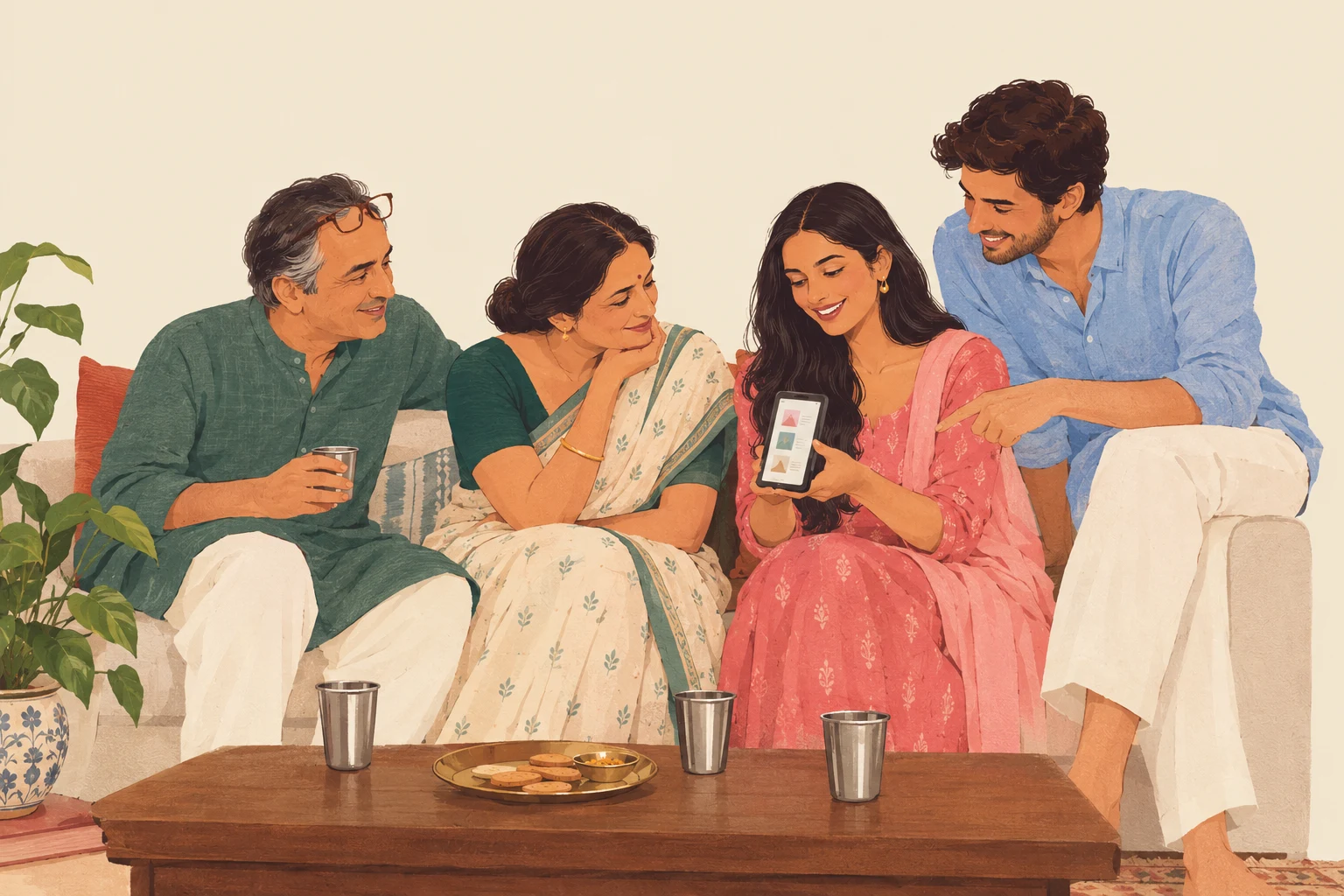
Building the wishlist is often the easy part. Explaining it to your parents is harder.
In many Indian families, telling people what to give still feels impolite, and a gift link next to the wedding date can read like a bill. The way through is to present the wishlist as help for your guests, not a request from you. It tells relatives what you will use, stops five people buying the same pressure cooker and still leaves room for the shagun envelope.
This guide covers how to raise it with your parents first, the reasons that tend to work with elders, and how to phrase it for everyone else. For ready-to-send messages, see our registry wording templates.
Is it rude to have a wedding registry in India?
No, but it can look that way to elders when it arrives without an explanation.
For your parents’ generation, wedding gifts ran on trust and memory. Guests chose something themselves or gave shagun in an envelope. Many families kept a register of who gave how much, so they could give a similar amount back at that family’s next wedding. Nobody announced what they wanted; choosing was part of the gift.
A registry changes that order. The couple says what they would like before anyone asks. To an elder, that can look like:
- Asking for gifts, which feels greedy.
- Putting a price on attending, which feels transactional.
- Taking away the guest’s choice, which feels impersonal.
Each of these is a fair worry. A good introduction answers them directly rather than brushing them aside.
Talk to your parents before anyone else
Your parents will get the questions. Relatives call the bride’s or groom’s mother to ask what the couple needs, and they will call again if the answer is a link nobody has explained. If your parents first hear about the wishlist from a cousin, they will feel left out of the decision and are more likely to object.
Show it to them before it goes to anyone else.
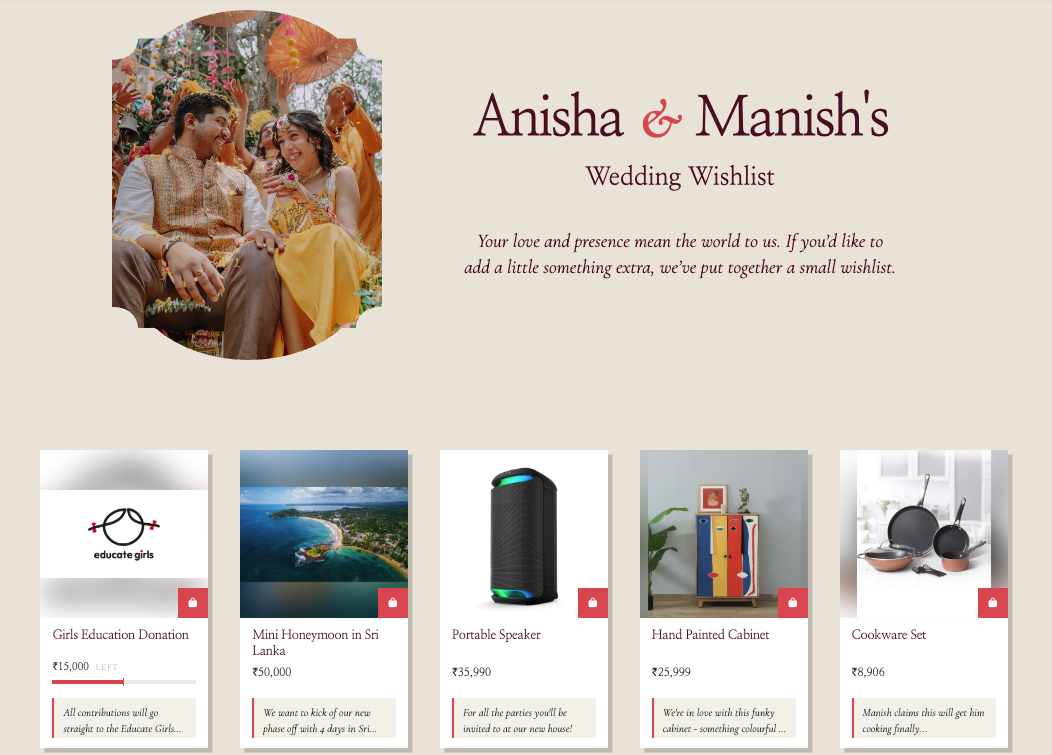
- Show the page, not the idea. Open the wishlist on their phone. A page with your photo, a line of welcome and a dinner set they can picture in your kitchen is easier to accept than the word “registry”.
- Ask them to add something. Most parents have views on what a new home needs. Put a few of their suggestions on the list and it becomes their list too.
- Pick a calm moment. Not in the middle of a caterer negotiation. A quiet evening after the guest list is settled works well, because the gift question is starting to come up anyway.
- Each of you talks to your own parents. In-laws hear it better from their own child than from the person their child is marrying.
Three reasons that work with elders
Fewer duplicate gifts
Most families have a story about the wedding that produced four dinner sets, three wall clocks and a mixer-grinder still in its box. Elders dislike waste as much as anyone. A list shows guests what you will actually use, and once someone reserves a gift it shows as reserved, so the next relative picks something else. Our piece on the hidden cost of gift guesswork has the numbers.

Less guesswork for relatives
Many guests want to give something useful but do not know your taste, the size of your flat or what you already own. Out-of-town relatives are often the least sure. A list answers “what do they need?” without your mother having to repeat it on every call. It also lets cousins or a group of friends put money together towards one larger gift, like a fridge or a sofa, instead of each buying something small.

To reserve a gift or contribute, guests sign in with a one-time code sent to their phone, or with Google or email, so older relatives do not need an email address.
Shagun with somewhere to go
Cash in an envelope is already the most common gift at many Indian weddings, so this reason often lands first. A cash fund on the wishlist does not replace shagun; it gives it a purpose. Instead of an envelope that disappears into the wedding budget, an elder can put money towards something specific and know where it went:
-
 A honeymoon fund for the trip after the wedding.
-
 A new home fund for the first sofa, fridge or rent deposit.
-
 A future fund for savings the two of you are building.
Contributions are paid inside Hazlnut and settled to your bank account after a flat 2% fee. Guests who prefer the envelope can still bring one.

What to say to your parents
You do not need a speech. Something short, in your own words and your family’s language, works better. A few starting points:
Mummy, lots of people are going to ask you what we need. Instead of you answering every call, we’ve made one list. You can just send them the link.
We don’t want people spending money on things that sit in boxes. This way they can see what we’ll actually use in the new house.
Shagun is still welcome. Anyone who wants to give cash can put it towards the honeymoon or the house, and we’ll know exactly who it came from.
It’s completely optional. Anyone who would rather bring a gift of their own choice, or nothing at all, is just as welcome.
If your parents are more at home in Hindi, Marathi, Tamil or Bengali, say it in that language. The reason matters more than the exact words.
Let your parents share it
Once your parents are on board, they are the best people to pass the link on, because relatives already ask them.
- Make a parent a co-host. You can invite up to three co-hosts by email. A co-host can edit the wishlist, add gifts and see contributions, so your mother can answer “has anyone taken the dinner set?” without calling you. Payments and settlements stay with you.
- Use one link in every chat. Ask both families to forward the same link rather than writing their own lists. Two lists bring the duplicates back.
- Keep the register, without the notebook. Hazlnut shows you who reserved each gift and who contributed to each fund, with any note they left. Your parents get the record they would once have kept by hand, and you get a ready list for thank-you messages.

How to phrase it for guests
Our wording guide has full templates for invitations and WhatsApp. These are the rules underneath them, with Indian weddings in mind.
- Blessings first, gifts second. Open with the celebration and their presence. The wishlist is the last line, not the first.
- Say it is optional, once. One clear “only if you’d like to” is enough. Saying it three times starts to sound like the opposite.
- Keep it off the printed card. The card is for the ceremonies, the venue and the family names. Put the link on a separate insert, the wedding website or the WhatsApp message that follows the e-invite.
- Welcome shagun and their own choices. Say plainly that envelopes and gifts they pick themselves are welcome too.
- Offer a range of prices. Include gifts under ₹2,000 as well as larger ones guests can contribute to, so nobody feels there is a minimum.
- Match the language of the invitation. If the card is in Hindi or Gujarati, the gift note can be too.
A short bilingual note, for example:
आपका आशीर्वाद ही हमारे लिए सबसे बड़ा उपहार है।
Your blessings are the greatest gift to us. For anyone who has asked what we would like, we have put together a small wishlist: [Wishlist link]. Shagun, a gift of your own choice or simply your company: all are equally welcome.
Some swaps that keep the tone warm:
| Instead of | Try |
|---|---|
| “Gifts: please see our registry.” | “If you’d like to give us something, here are a few ideas.” |
| “No boxed gifts, please.” | “We’d love help setting up our first home, and anything you choose is welcome.” |
| “Cash only.” | “If you were planning to give shagun, you can also put it towards our honeymoon fund.” |
| “Suggested amount: ₹5,000.” | Leave amounts out. Let guests decide. |
When an elder still says no
Some grandparents will not come round, and that is fine.
- Leave them out of it. Do not send the link to relatives who would be offended. Let them give the way they always have.
- Let your parents choose who gets it. They know which uncles will appreciate a list and which will not.
- Thank everyone the same way. A gift that was not on the list, even a fourth pressure cooker, still deserves a proper thank-you.
The wishlist is there for guests who want help choosing. It does not need everyone’s approval to do that.
A quick checklist
- Both sets of parents have seen the wishlist on their own phones.
- The list has gifts at different prices, starting under ₹2,000.
- Each cash fund names a real plan: the honeymoon, the home, your savings.
- A parent is a co-host, if they want to help.
- The link is in the WhatsApp message or on the wedding website, not on the printed card.
- If you are taking contributions, your bank account setup is complete before you share.
Ready to send it? Use our wording templates for invitations and WhatsApp, or follow the step-by-step guide to creating a wedding registry. To see what guests can do, read about our wedding gift registry in India.
Start with your family
Make a wishlist your parents will be happy to share
See what guests see, or start your own and show it to your parents first.